How Souppe turns portfolio risk into the next decision
Souppe shows you where your portfolio is fragile and gives you targeted enhancements. Choose which security suggestion you believe in, and watch how it reshapes the portfolio's risk. Here are the five Souppe steps investors repeat, while keeping their investment judgment.
Working together
Souppe works with you. It takes the systematic side, the part software does better than a human, granting you the freedom to focus on investment conviction. It reads how a portfolio behaves, where it is fragile, and which targeted changes would make it more resilient to various shocks.
As the investor, you control everything. While you bring your investment wisdom and reason behind each holding, Souppe makes sure the suggested securities are a logical addition to your portfolio. We provide security suggestions that come to strengthen your portfolio and make it more resilient to the events that naturally occur.
That stays true for any type of investor: A retail investor wants to know how much their portfolio is sensitive to a market downturn. A portfolio manager wants to control the risk across multiple portfolios, each suitable for a different client and risk preference. An allocator wants to stay within given risk boundaries. The questions underneath are always the same: What is the real risk in this portfolio, and what is the smallest change that would make it stronger?
Investors use Souppe as a personal systematic risk assistant:
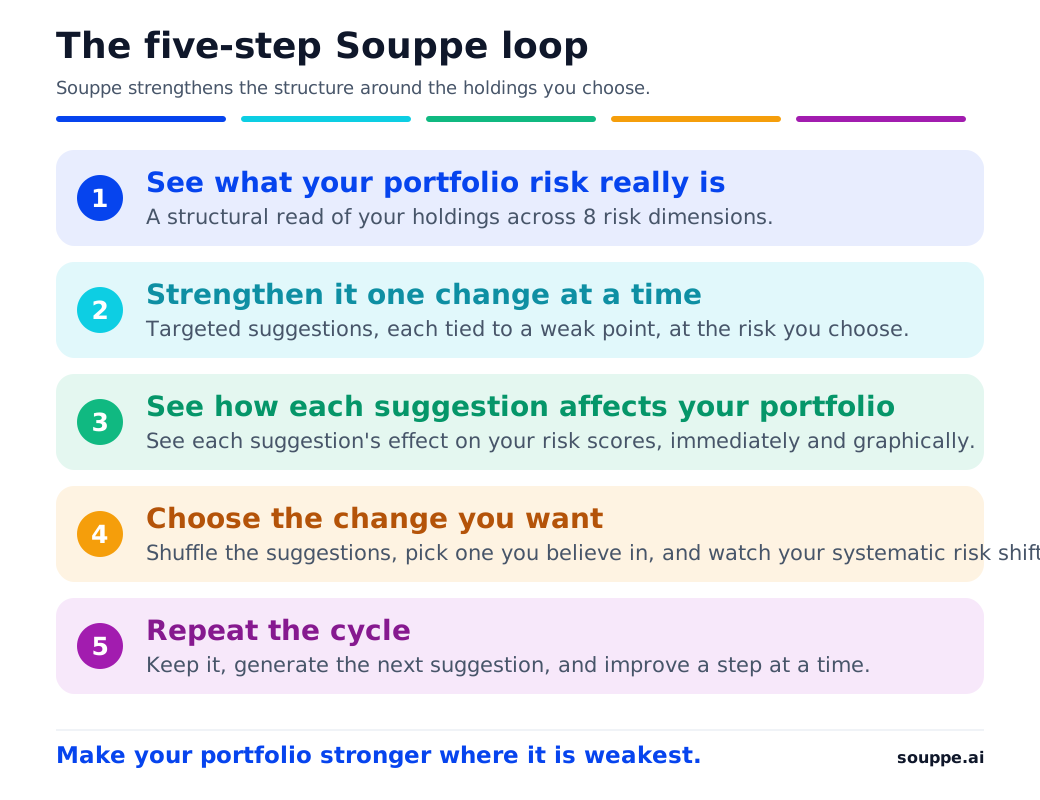
See what your portfolio really is
The first step is the simplest. You input your holdings and get back a structural risk mapping of the portfolio. Souppe scores the portfolio across 8 systematic risk dimensions, representing the different perspectives where your portfolio might fail. Three measure diversification: whether the spread is real or only cosmetic, how many parts of the market it leans on, and whether a few names quietly dominate. Two measure downside risk: how much it tends to fall when the market falls, and how tightly its holdings move together in a severe selloff. The remaining three look at the whole portfolio at once: how easily it can be traded, how steady its sensitivity to the broad market stays across conditions, and how much of its movement comes from systematic drivers rather than company-specific surprises.
On top of those sit three plain-language scores that represent the bottom line, the expected behavior of the portfolio: how crash-resistant the portfolio is, how much growth it captures, and how steadily it holds up across good markets and bad.
Strengthen your portfolio one change at a time
Measurement without action is half a tool, so the second step is the creation of suggestions. Souppe ranks where the portfolio is thin and proposes specific securities that would shore up each soft spot, every suggestion tied to the weakness it is meant to close and every one showing its expected effect before you commit. The names you believe in stay. The model improves what surrounds them.
See how each suggestion affects your portfolio
You see the potential improvement on your portfolio's expected risk characteristics immediately and graphically. As you sift through the model-suggested securities, your portfolio's risk scores change to show what it would look like if you added that security. You can keep looking until you find a security that matches your investment conviction. A basic rule is to only diversify as long as we have something smart to say about the security we add into our portfolio.
Choose the change you want
The fourth step puts you in charge of the second. Souppe ranks its suggestions, but the top one is never an order. You shuffle through the ranked picks until you reach a security you actually want to own, one you have a view on, and the model shows how adding it would reshape the systematic side of your risk before you commit a cent.
The same portfolio gives different people different answers. You set a risk level and a tilt. Defensive for the client who fears the next selloff, growth for the one chasing upside, balanced in between. A manager can run one client's holdings three ways and hand each client the version that matches how much risk they actually want. Most of the benefit lands early. In testing, by the fifth suggested change the measured worst-case loss was about 12 percentage points shallower, so no one has to rebuild a portfolio to move the number.
Repeat the cycle
The fifth step is the entire process. It ties the other four together. Once a change is in, the portfolio is a different shape, and its weakest point has usually moved somewhere new. So you ask Souppe for the next suggestion against the updated holdings, weigh it the same way, keep it or shuffle for one you prefer, and read the structure again.
A portfolio is never fixed in a single pass. It gets sturdier, one deliberate change at a time, and the cycle hands you a clear next step instead of a one-shot verdict you have to take or leave.
Putting it together
Those five steps are the entire process. You see the structure, strengthen the weak points, see the influence, choose the change you believe in, then run it again. The same process runs whether the holdings sit in one retirement account or across a room of institutional portfolios, which is what the use-case gallery shows for a retail saver, a manager, a family office, a hedge fund, an ETF manager and an allocator.
And it is not a leap of faith. Measured forward across 26 years, about 77% of the tested Souppe portfolios fell less than the S&P 500 through its downturns, and run across 500 disclosed institutional portfolios last quarter the first change it suggested improved 88% of them.